[takeaways] • India's largest desert is the Thar Desert, also called the Great Indian Desert, spanning roughly 200,000 square km (about 77,000 square miles) – just smaller than the US state of Nebraska.
• It sits mainly in Rajasthan, extending into the Punjab and Sindh provinces of Pakistan, in India's northwest.
• Highlights include towering dune fields, clear stargazing skies, camelback and 4x4 safaris, and the UNESCO-listed Desert National Park.
• The mildest season to visit is October through March; avoid April to June's extreme heat, and expect monsoon rain between July and September.
• Pack for sun and heat, agree on transport prices upfront, and dress modestly in remote villages.
• A SIMOVO eSIM for India can help keep you connected to loved ones while exploring India's towns and cities. [/takeaways]
When you think of deserts, you may think of Northern Africa, or somewhere across the most barren stretches of North America – but, even India is home to sandy, arid stretches, and there's one desert in particular that's utterly fascinating. Not just for its size, of course, but also for its location, geography, and history.
The largest desert in India is the Thar Desert. It's actually known by many as the Great Indian Desert (rather fittingly!), and it's home to a national park and several conservation zones. If you're considering a trip to India soon or are specifically looking for new desert destinations to explore, this could well be somewhere you'd like to prioritize.
Before you do, however, always make sure you have a SIMOVO eSIM for India installed to your smartphone. SIMOVO's eSIMs are designed to offer you as much coverage as possible from the best mobile networks across the globe – and in this case, when you're visiting India's major towns and cities, your phone will connect to the best available coverage.
Just remember that even with the best phone and coverage out there, deserts can always be blind spots for staying connected to the wider world! Let's dive into what you need to know about the Thar Desert.
[esim flag="🇮🇳" label="India" data="10GB · 30 days" price="$18.50" href="/products/india" benefits="Instant QR setup · Reliable 4G/5G · No contract"]Get set up with a SIMOVO eSIM before you head to India, so your coverage is ready the moment you land[/esim]
Where is India's largest desert?
The Thar Desert region is found close to the Indus River plain, though it is also close to the Rann of Kachchh and Punjab. You'll find it mainly in the Indian state of Rajasthan, extending into the Punjab and Sindh provinces of Pakistan, according to Britannica.
From a map perspective, the Great Indian Desert actually sits fairly neatly across the country border with Pakistan, to the North West of India. In fact, some of the desert technically crosses into Pakistan, despite its name referring to India alone.
How big is India's largest desert?
India's Thar Desert is impressively huge at around 200,000 square km or 77,000 square miles, again, according to Britannica. That makes it just smaller than the entire US state of Nebraska, which is impressive in and of itself – as Nebraska is the 16th largest state in the US.
As you may expect, Thar Desert is much less densely populated than Nebraska! It's home to people who live in rural gatherings around the general area, with a variety of ethno-diverse groups of nomadic people residing across the sands.
Thar Desert, despite having some attractions and points of interest, is fairly remote – water is reasonably scarce here and there are few connections via public roads and railway links. You may, for example, be able to get rare transportation connections here from Jaisalmer, or if you are visiting from Pakistan, from Hyderabad.
Despite the size of the desert in relation to the rest of India, it is in fact relatively small compared to some of the other famous arid regions you've probably heard of! The Sahara Desert in Africa, for example, covers a staggering 9.2 million square km or 3.6 million square miles, making it comparable to the size of the US, period! Incredible to think of – but, before you start tackling the Sahara, it's best to start with somewhere like Thar.
What are some of the most popular attractions close by?
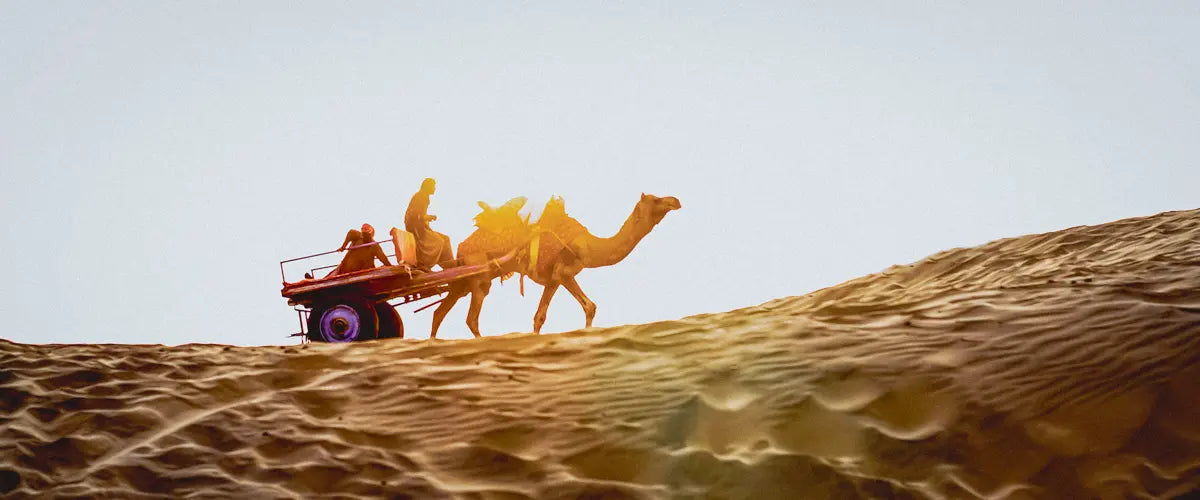
Despite being an arid region, Thar Desert does have a variety of points of interest that many people enjoy visiting. For example, according to Mandala Tours, one key reason to visit is to marvel at the stunning dune fields and hills that can reach 100 meters or more in height. It's also a fabulous corner of the world to go stargazing, with little to no light pollution spoiling the panorama.
Mandala Tours' guide also notes that the area is fantastic for wildlife spotting and for taking nomadic safaris or tours on camelback. Typically, to cross the desert faster, you'd take a 4x4 jeep. Many visitors even take the opportunity to sleep under the stars – a great experience if you're used to slumming it in hotel rooms and are tired of the same old painted ceilings!
The desert's incredible biodiversity has given rise to some serious conservation efforts that continue to protect animal and plant life alike across the region. It's home to the likes of gray wolves, Indian pangolins, blue bulls, skittering frogs, Indian star tortoises, and caracals.
There's also the fantastic Desert National Park, which has been recognized by UNESCO as part of its Tentative Lists collection. UNESCO notes that the desert park itself covers around 3,162 square km, or 1,220 square miles, and that it is home to threatened species such as the Great Indian Bustard, one of many endemic species to the region.
When is the best time to visit the Thar Desert?
The mildest and most comfortable time of year to explore the Thar Desert is usually around October through to March. This way, you're experiencing a winter season with clear nights and cool enough temperatures to withstand some trekking and camel rides.
You should certainly avoid visiting the area between April and June, which is when the temperatures absolutely skyrocket – harsh heatwaves and severe dust storms are likely.
The Thar Desert is typically dry across the year, though it does experience a monsoon season between July and September, when it's likely to be very humid and experience some rainfall.
Tips for visiting the Thar Desert
To make the most of any trip to the Thar Desert, always remember the following tips.
[warning]Focus on staying hydrated. Make sure to carry electrolyte packets and bottled water for as long as you are traveling across the region.[/warning] [tip title="Prioritize sun protection"]Pack with sun protection as a priority. Ensure you have headgear such as a wide-brimmed sun hat, sunglasses, and a high-SPF sunscreen.[/tip] [tip title="Dress modestly in remote villages"]It's good practice to dress as modestly as you can when visiting remote villages, many of which are highly religious and traditional.[/tip] [tip title="Agree on prices upfront"]Always agree on the prices you can expect to pay for journeys across the sands, such as via rickshaw, camel, or jeep.[/tip] [tip title="Compare safari options"]Look closely at a range of different safari options, such as those that specialize in overnight sleep-under-the-stars experiences and more high-octane camp shows and events.[/tip]
Tips for visiting India
To close our guide, let's run through some must-try tips when visiting India in general whether or not you head into the Thar Desert.
[tip title="Expect crowds"]India is now the world's most populated country, meaning you can certainly expect many non-desert spaces to be fairly busy! If you're not a big fan of crowds, be sure to set yourself expectations before you visit.[/tip] [warning]The bottled water rule applies across India, simply because the tap water here isn't safe to drink. Make sure you have some available when brushing your teeth and to freeze for ice, too.[/warning] [tip title="Follow the queues for great food"]If you're interested in a trip to India for the incredible food, always trust restaurants and street vendors with long queues. The dishes are likely to be great quality and very likely the tastiest around![/tip] [warning]Be sure to check you have all relevant vaccinations and that you are cleared to travel by your doctor or physician before visiting India. It's also wise to pack a travel medical kit, including electrolytes, rehydration salts, and stomach remedies.[/warning] [faq] [q]What is the largest desert in India?[/q] [a]The Thar Desert, also known as the Great Indian Desert, is India's largest desert, spanning around 200,000 square km (about 77,000 square miles).[/a] [q]Where is the Thar Desert located?[/q] [a]It sits mainly in the Indian state of Rajasthan, extending into the Punjab and Sindh provinces of Pakistan, in India's northwest.[/a] [q]When is the best time to visit the Thar Desert?[/q] [a]October through March is mildest; avoid April to June's extreme heat, and expect monsoon rain between July and September.[/a] [q]Is the Thar Desert bigger than the Sahara Desert?[/q] [a]No – the Sahara covers around 9.2 million square km, making it vastly larger than the roughly 200,000-square-km Thar Desert.[/a] [q]Is tap water safe to drink in India?[/q] [a]No – stick to bottled water throughout, including for brushing your teeth and for ice.[/a] [/faq] [esim flag="🇮🇳" label="India" data="10GB · 30 days" price="$18.50" href="/products/india" benefits="Instant QR setup · Reliable 4G/5G · No contract"]Grab an India eSIM and stay connected across towns and cities[/esim]