[takeaways] • Two weeks covers both islands comfortably without feeling rushed.
• Self-drive is the best approach — public transport is limited outside the cities.
• The Interislander ferry connects the islands between Wellington and Picton.
• The Tongariro Alpine Crossing and Milford Sound both require advance booking.
• Phone coverage has gaps in remote areas — download maps offline before you go.
• A New Zealand eSIM keeps you connected from the moment you land. [/takeaways]
Two weeks in New Zealand is the sweet spot. It is enough time to experience the best of both the North and South Islands without feeling like you are constantly rushing from one highlight to the next. And the best way to do it? Self-drive, without question.
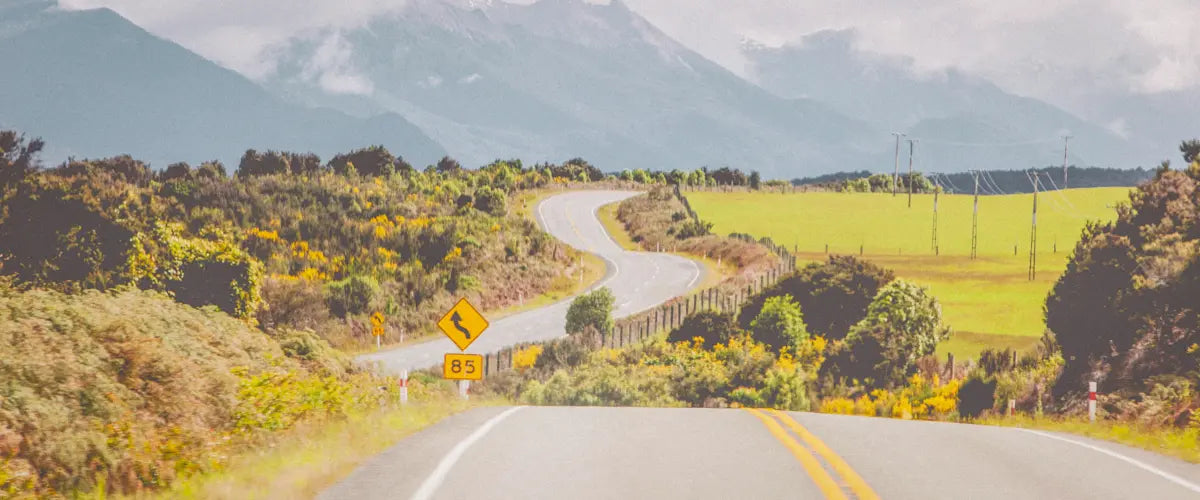
New Zealand is practically built for road trips. The highways connect almost every major attraction, the scenery along the way is often as spectacular as the destinations themselves, and having your own wheels means you can stop wherever you want, whenever you want. No tour bus timetables. No waiting around.
This itinerary covers a fortnight on the road, starting in Auckland and finishing in Queenstown, with the ferry crossing between the two islands as the natural midpoint. It is designed for independent travelers who want to see a lot without sacrificing the freedom to linger when somewhere catches their eye.
[esim flag="🇳🇿" label="New Zealand" data="10GB · 30 days" price="$13.70" href="/products/new-zealand" benefits="Instant QR setup · Reliable 4G/5G · Hotspot supported"]Stay connected on your New Zealand road trip[/esim]
Before you set off: New Zealand driving basics
Before we get into the day-by-day plan, a few things are worth knowing about driving in New Zealand.
New Zealand drives on the left. Speed limits are in kilometers per hour, with an open road limit of 100 km/h — but many rural roads are windier and slower than your GPS will suggest, so always allow more travel time than the map tells you. Gas stations can be far apart in remote areas, particularly on the South Island's West Coast, so fill up whenever you get the chance.
[warning]Many South Island roads are single-lane or unsealed gravel. Check your rental car's insurance terms before you travel — some policies exclude gravel road damage entirely.[/warning] [tip title="Book early"]Accommodation at popular stops like Queenstown, Milford Sound, and Tongariro fills weeks ahead in peak season (December to February). Lock in key nights before you fly.[/tip]
North Island vs South Island: at a glance
| North Island | South Island | |
|---|---|---|
| Best for | Culture, cities, geothermal | Adventure, wilderness, scenery |
| Driving | Motorways and main highways | Winding mountain and coastal roads |
| Top stop | Tongariro National Park | Milford Sound |
| Ferry connection | Wellington (depart) | Picton (arrive) |
| Days in this itinerary | 7 | 7 |
Week one: The North Island
Days 1 and 2: Auckland
Most international flights into New Zealand land at Auckland, making it the natural starting point. Two days here gives you time to recover from the journey, pick up your rental car, and get your bearings before hitting the road.
Auckland has plenty to fill your time. The Sky Tower is the obvious landmark, and the views from the top are worth it on a clear day. The Waitemata Harbour is the heart of the city, and a walk along the waterfront to the Viaduct Harbour is a pleasant way to ease into things. If you have a full day to spare, the ferry to Waiheke Island makes an excellent half-day trip, with good wineries and beaches within easy reach of the terminal.
Day 3: Auckland to Rotorua via Hobbiton
The drive from Auckland to Rotorua takes around three hours on a direct route, but if you can spare an extra couple of hours, the Hobbiton Movie Set near Matamata is a genuinely impressive detour — especially if anyone in your group has a fondness for the Lord of the Rings films.
[tip title="Book Hobbiton before you leave home"]Hobbiton regularly sells out weeks in advance. Tickets cannot be bought at the gate — visit hobbitontours.com and book as early as possible.[/tip]
You will arrive in Rotorua by mid-afternoon — a good time to explore the town and get a feel for the geothermal activity that makes this place unlike almost anywhere else on earth. The sulfurous smell is real. You do get used to it.
Day 4: Rotorua
A full day in Rotorua is well spent. Te Puia combines the Pohutu Geyser — one of the largest active geysers in the Southern Hemisphere — with a living Maori cultural experience, and it is the best single attraction in the area. For something more active, Whakarewarewa Forest has some of the best mountain biking trails in New Zealand.
If the budget allows, an evening Maori hangi — a traditional feast cooked in the ground — is both an excellent cultural experience and a genuinely good meal.
Day 5: Rotorua to Taupo and Tongariro
Lake Taupo is about an hour south of Rotorua and worth a stop on the way through. The lake is enormous — roughly the size of Singapore — and the views toward the volcanic peaks of Tongariro National Park on a clear day are hard to forget.
Tongariro National Park is the crown jewel of the North Island. The Tongariro Alpine Crossing is widely regarded as one of the best day walks in the world: a 19.4 km trail through volcanic craters, across lunar landscapes, and past vivid emerald lakes that takes most people six to eight hours.
[warning]The weather on the Tongariro Alpine Crossing can turn severe without warning. Check the forecast on the morning of your walk and do not attempt it in poor conditions. Proper walking boots and waterproof layers are not optional.[/warning]
Even if the walk is not on your agenda, driving through the park and stopping at the viewpoints is spectacular in its own right. Stay overnight near Tongariro or in National Park village.
Day 6: Drive south to Wellington
From Tongariro to Wellington is around a three-hour drive south — a straightforward route with a few worthwhile viewpoint stops along the way. Wellington is New Zealand's capital and a genuinely likeable city: compact, walkable, and with an excellent food and coffee scene. Spend the evening in the Cuba Street area, which has the best concentration of restaurants and independent shops in the city.
Day 7: Wellington and the ferry to Picton
Give yourself a half-day in Wellington before heading to the terminal. Te Papa Tongarewa, the national museum, is free to enter and worth a couple of hours. The cable car up to the Botanic Garden is a quick and scenic way to see the city from above.
[tip title="Book the ferry well ahead"]The Interislander from Wellington to Picton takes around three and a half hours, and the crossing through the Marlborough Sounds is genuinely beautiful. Book your sailing in advance — particularly if you are traveling with a rental car.[/tip]
"The Interislander crossing through the Marlborough Sounds is one of those journeys where you realise the trip itself is the destination."
Week two: The South Island
Day 8: Marlborough and Nelson
Picton is the gateway to the South Island. The Marlborough Sounds, which surround the town, are best seen from the water — even a short water taxi trip around the inlets is worthwhile if you have the time.
The drive from Picton to Nelson takes about an hour and a half through the Marlborough wine region, home of New Zealand's famous Sauvignon Blanc. Nelson itself is a relaxed coastal city with good restaurants and easy access to Abel Tasman National Park, which is worth a morning visit before pushing on.
Day 9: The West Coast — Punakaiki and onward to Franz Josef
This is one of the most dramatic driving days of the entire trip. From Nelson, head south and west through the mountains toward the West Coast.
The Pancake Rocks at Punakaiki are one of New Zealand's most distinctive natural landmarks — layered limestone formations with blowholes that shoot spray into the air when conditions are right. It is a short walk from the parking lot and absolutely worth a stop.
[warning]Phone coverage on parts of the West Coast is limited or non-existent. Download your maps offline before leaving Nelson and check that your eSIM data is active before you lose signal on the remote sections south of Greymouth.[/warning] [tip title="Fill up before heading south"]Gas stations become sparse south of Hokitika. Fill the tank in town — the next reliable station could be over 100 km away.[/tip]
Continue south along the coast to Franz Josef, arriving by late afternoon.
Day 10: Franz Josef Glacier and the drive to Wanaka
Franz Josef Glacier is one of the most accessible glaciers in the world. Hike to the valley floor viewpoint for a sense of its scale, or book a helicopter tour over the ice if the budget allows.
From Franz Josef, the drive southeast to Wanaka takes around four hours through the remote Haast Pass — one of the most isolated stretches of the whole itinerary. Fill up with gas before leaving Franz Josef.
Wanaka is quieter and less commercial than Queenstown, with spectacular lake views and a strong restaurant scene. It makes an excellent base for the final stretch of the trip.
Day 11: Wanaka to Queenstown
The drive from Wanaka to Queenstown takes under an hour via the Crown Range Road — the highest sealed road in New Zealand, with views to match. Alternatively, the Kawarau Gorge route passes the original AJ Hackett bungee site on the Kawarau Bridge, where you can watch or participate.
Queenstown is the adventure capital of New Zealand. Skydiving, bungee jumping, jet boating, white water rafting, paragliding — it is all here. Or you can walk along the lakefront, eat well, and watch the Remarkables turn pink at sunset. Plan on two nights minimum.
Day 12: Queenstown
Use your second day to tick off the adventure activity you have had in mind, or take a half-day trip to Arrowtown — a well-preserved gold rush town about 20 minutes away — or Glenorchy at the northern end of Lake Wakatipu.
[tip title="Book Milford Sound now"]If you have not already booked your cruise for the following day, do it tonight. Morning departures offer the best light for photography, and popular sailings sell out well ahead.[/tip]
Day 13: Milford Sound day trip
Milford Sound is the most visited attraction in New Zealand, and the reputation is deserved. The fiord is flanked by sheer cliffs rising over a kilometer from the water, with waterfalls cascading down in almost any weather — and when it rains, the falls multiply and the atmosphere becomes something else entirely.
The drive from Queenstown takes around two and a half hours each way through Fiordland National Park, which is spectacular in its own right. A boat cruise is the standard way to experience it. Book well in advance.
Day 14: Queenstown, then home
Your final day. Depending on your flight time, you may have the morning free for one last walk, a flat white, or a browse through town before heading to Queenstown Airport. Queenstown has direct international connections, with flights to Auckland, Sydney, and beyond.
Practical tips for your New Zealand road trip
[tip title="Sort your eSIM before you fly"]A New Zealand eSIM from SIMOVO activates the moment you land — no SIM swapping, no roaming charges, no bill shock when you get home. You will be navigating from the airport parking lot before your bags have arrived on the belt.[/tip] [tip title="Allow more time than your GPS suggests"]Rural New Zealand roads are often winding, single-lane, or shared with slow campervans. Every driving estimate in this itinerary assumes reasonable conditions — build buffer time into every day wherever you can.[/tip] [tip title="Carry cash for rural stops"]Card is widely accepted across New Zealand, but some rural businesses, Department of Conservation huts, and roadside stalls operate on cash only.[/tip] [tip title="Pack layers for every season"]New Zealand weather is famously changeable, particularly on the South Island. A waterproof jacket and a warm mid-layer belong in your bag regardless of when you travel.[/tip]
Frequently asked questions
[faq] [q]Do I need an International Driving Permit for New Zealand?[/q] [a]If your driving license is in English, you can drive in New Zealand without an IDP for up to 12 months. If your license is not in English, you will need a certified translation or an IDP. Always carry your license with you.[/a] [q]When is the best time to visit New Zealand?[/q] [a]The New Zealand summer runs from December to February and offers the best conditions for both islands. Shoulder seasons (March to May and September to November) are quieter and still very pleasant. Winter (June to August) is colder on the South Island, but skiing in Queenstown and Wanaka is excellent.[/a] [q]Do I need a visa to visit New Zealand?[/q] [a]Citizens of many countries — including the UK, US, Australia, and most EU nations — can visit visa-free or with an NZeTA (New Zealand Electronic Travel Authority), which is a straightforward online application. Check the current entry requirements for your nationality before you travel.[/a] [q]Is phone coverage reliable in New Zealand?[/q] [a]Coverage is good in cities and along most main routes, but rural and remote areas — particularly the West Coast and Fiordland — have significant gaps. Download offline maps before leaving urban centers, and a SIMOVO New Zealand eSIM will keep you connected wherever coverage is available.[/a] [q]Can I complete this itinerary in a standard rental car?[/q] [a]Yes — this itinerary stays on sealed roads throughout. You do not need a 4WD or campervan, though a campervan is a popular alternative if you want more flexibility with accommodation. If you plan any detours onto gravel roads, check your rental car's insurance terms first.[/a] [q]How far in advance should I book the Interislander ferry?[/q] [a]At least four to six weeks ahead in peak season (December to February), especially if you are traveling with a rental car. Outside peak season, two to three weeks is usually sufficient — but earlier is always better.[/a] [/faq] [esim flag="🇳🇿" label="New Zealand" data="10GB · 30 days" price="$13.70" href="/products/new-zealand" benefits="Instant QR setup · Reliable 4G/5G · Hotspot supported"]Stay connected on your New Zealand road trip[/esim]