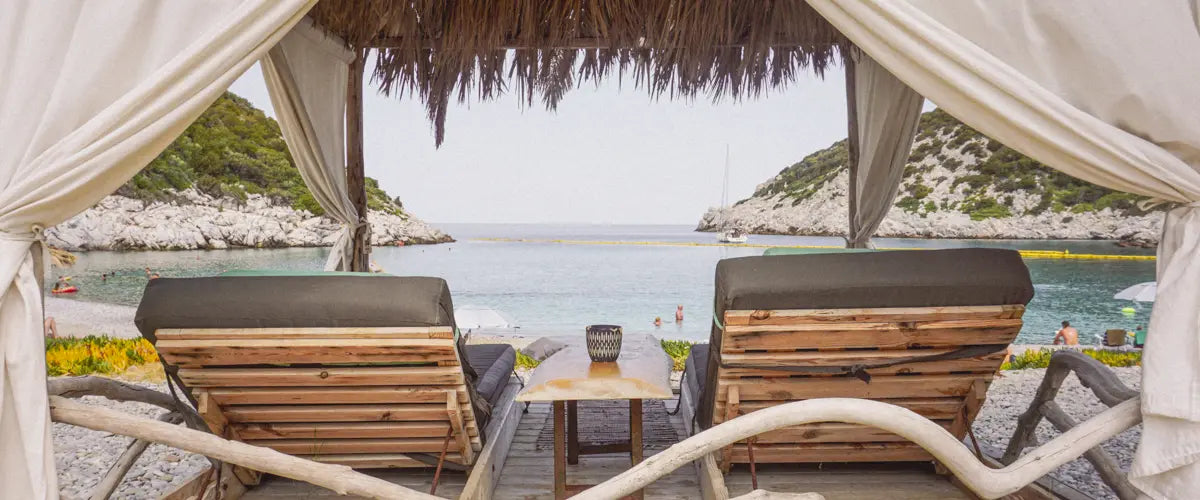
Whether it's Greek weather, Greek food, or Greek history — there are tons of great reasons to visit Greece across the year. That said, if there's one thing that tops the lists of most of the SIMOVO team for Mediterranean breaks away, it's Greece's glorious beaches.
Given that the sun shines down on the region and its islands all year, what is it that really separates the best beaches in Greece? In this guide, we take a close look at the most beautiful sandy stretches across the country and break down what to expect when you land.
Best beaches in Greece overview
Greece is one of the luckiest countries on the planet when it comes to sunshine and sparkling waters, and it's all the more reason to add its best beaches to your Greece itinerary. What separates the best beaches varies — in terms of what they're suited to, their proximity to other attractions, and features such as panoramic views.
From secluded bays to open tourist spots, there's a wide choice for almost every beach lover here. We recommend taking on board our picks and then checking out what other travellers have to say — and ultimately, the best way to find your favourite Greek beach is to get out there and explore for yourself.
Most beautiful beaches in Greece
The SIMOVO team agrees that this list could go on for much longer — but we've narrowed our top picks down to Navagio Beach, Myrtos Beach, Sarakiniko Beach, Porto Katsiki, Red Beach, and Elafonisi Beach. Here's why each one is well worth the towels and parasols.
[numbered title="Navagio Beach" pill="The Shipwreck Beach"]One of the most dramatic beaches in Greece — a rusted shipwreck on white sand enclosed by towering cliffs. Only accessible by boat, which adds to the sense of occasion.[/numbered] [numbered title="Myrtos Beach" pill="Blue waters and pebbles"]Famous for its vivid blue waters and white pebbled sand on Kefalonia — a little off the beaten track but a favourite for sunset watching and pure sun lovers.[/numbered] [numbered title="Sarakiniko Beach" pill="White rocks and cliffs"]Gorgeous white volcanic rocks and sparkling waters on Milos — a beautiful and often underrated stop that deserves far more attention than it gets.[/numbered] [numbered title="Porto Katsiki" pill="Limestone cliffs and secret escape"]Dramatic limestone cliffs and crystal clear Ionian waters on Lefkada — challenging to reach for some, but a firm favourite for those who make the effort.[/numbered] [numbered title="Red Beach" pill="Red volcanic cliffs"]Named for its striking red cliffsides, this Santorini standout — also known as Kokkini — is one of the most dramatic coastal landscapes anywhere in the Greek islands.[/numbered] [numbered title="Elafonisi Beach" pill="Pink coral sand"]Long, wide, and dreamlike — the pink tint from coral and shells makes Elafonisi one of the most visually unique beaches in all of Greece. Best visited off-season.[/numbered]Navagio Beach, Zakynthos
Navagio Beach is commonly known as the Shipwreck Beach — named after the dramatic ruins of a rusting ship that wrecked here some 40 years ago. It's considered one of the most dramatic-looking beaches in Greece, with an impressive clifftop lookout high above the enclosed cove below. There's a reason it's one of the most-visited beaches in the whole country.
Myrtos Beach, Kefalonia
Myrtos Beach is another sandy stretch that demands to be experienced in person. It's famous for its dynamic blue waters and white pebbled sand, and while it may be a little off the beaten track for some travellers, it remains a genuine tourist highlight. Many people recommend the area specifically for sunset watching — it's an otherwise pared-back beach resort purely for sun and sea lovers.
Sarakiniko Beach, Milos
Sarakiniko is a must-visit if you're sailing out to Milos during your Greek adventure. Gorgeous white volcanic rocks and sparkling waters balance a lovely sandy stroll with dramatic cliff scenery, and it's not too far a drive from local towns and attractions. Sarakiniko tends to get forgotten among the bigger beach names — make sure to give it some love the next time you're in the Mediterranean.
Porto Katsiki, Lefkada
Porto Katsiki — known to many as the Goat Port — has a firm spot in the hearts of SIMOVO's Greece adventurers. This Ionian escape offers tremendous limestone cliffs and genuinely clear blue waters. It's something of a secret getaway for many, as while it can get busy, getting here can be a challenge — which keeps the crowds slightly more manageable than at some of the more accessible beaches on this list.
Red Beach, Santorini
Otherwise known as Kokkini, Red Beach is so-called because of the striking colour of its cliffsides. It's considered a great example of the picturesque and dramatic sandy stretches that Greece has to offer — a genuinely unique landscape and a rare beach escape for anyone holidaying in Santorini.
Elafonisi Beach, Crete
Elafonisi Beach is our pick for Crete's best sandy stretch. Long, wide, and truly dreamlike to look at — particularly during the off-season, as it becomes extremely popular when tourist season descends in full. The road to get here can be a little tricky, but it's absolutely worth it to see the pink tint from coral and shells up close.
[tip title="Visit Elafonisi in shoulder season for the best experience"]Elafonisi is one of the most photographed beaches in Greece — which means in peak summer it becomes genuinely crowded. Visit in May, June, or September to experience the pink-hued sand and shallow lagoons without competing for space. The natural colour is best appreciated in the morning light.[/tip]Best Greek islands for beaches
If you've already started looking into Greek sailing itineraries, you'll want to know which islands deliver the best beach experiences. Based on our list, we feel the most spectacular sandy stretches are available in Lefkada, Crete, and Milos — but tastes vary, and there's a lot of choice across the islands.
[tip title="Paros for parties, Naxos for families"]For family-friendly beach adventures, Paros and Naxos both deliver excellent coastlines with calmer conditions. Paros in particular has a well-established party beach scene alongside its quieter stretches — ideal if you want the option to switch between the two depending on the day.[/tip]Best time to visit beaches in Greece
If your Greek adventures revolve around its best beaches, September is the month we'd most recommend. The weather is still bright and warm, much of the peak tourist crowd has dispersed, and the sea is at its warmest following the summer — giving you the best of all conditions simultaneously.
[tip title="September is the sweet spot for Greek beaches"]Summer delivers the warmest water and the most reliable sunshine, but also the biggest crowds. Off-season spring and autumn visits are more affordable and less busy, though not all attractions will be fully open. September sits perfectly between the two — warm, sunny, quieter, and still fully open for business.[/tip]Tips for visiting beaches in Greece
Here are some must-try tips for visiting Greece's beautiful beaches.
[tip title="Bring your own beach equipment"]Never hire a sun lounger or parasol when you can bring your own. Equipment hire at popular Greek beaches — particularly in Santorini and Mykonos — can be expensive. A lightweight travel towel and a compact folding mat take up minimal space and save you money across the whole trip.[/tip] [warning]Sea urchins are a genuine hazard at many Greek beaches, particularly around rocky shorelines and shallow reef areas. A sea urchin sting is painful and the spines can be difficult to remove without medical help. Always wear water shoes or beach shoes when entering the water at rocky beaches — this applies to Navagio, Red Beach, and Sarakiniko in particular.[/warning] [warning]Never touch wild marine life at Greek beaches and always obey safety warnings and flags at the water's edge. Only swim or dive in open water if you are a confident swimmer — currents can be stronger than they appear from the shore, and some of the more dramatic beaches on this list are not supervised by lifeguards.[/warning] [esim flag="🇬🇷" label="Greece" data="10GB · 30 days" price="£9" href="/products/greece" benefits="Instant QR setup · Reliable 4G/5G · No contract"]Stay connected across the Greek islands — no roaming charges[/esim] [faq] [q]What are the most beautiful beaches in Greece?[/q] [a]The six most beautiful beaches in Greece are Navagio Beach on Zakynthos (the famous Shipwreck Beach, accessible only by boat), Myrtos Beach on Kefalonia (vivid blue waters and white pebble sand), Sarakiniko Beach on Milos (dramatic white volcanic rocks), Porto Katsiki on Lefkada (limestone cliffs and crystal clear Ionian water), Red Beach on Santorini (striking red volcanic cliffsides), and Elafonisi Beach on Crete (pink-tinted coral sand and shallow lagoons).[/a] [q]What is Navagio Beach?[/q] [a]Navagio Beach — also known as Shipwreck Beach — is located on the island of Zakynthos and is one of the most iconic and photographed beaches in Greece. It is enclosed by towering white limestone cliffs and features the dramatic rusted wreck of a ship that ran aground here in 1983. The beach is only accessible by boat from nearby ports, which adds to its secluded and spectacular atmosphere.[/a] [q]What is Elafonisi Beach?[/q] [a]Elafonisi Beach is located on the southwestern tip of Crete and is famous for its shallow turquoise lagoons and the distinctive pinkish tint of its sand, which comes from crushed coral and shells. It is one of the most beautiful and photogenic beaches in Greece, though it becomes extremely crowded in peak summer. Visiting in May, June, or September gives a significantly better experience.[/a] [q]When is the best time to visit Greek beaches?[/q] [a]September is widely considered the best month for beach visits in Greece — sea temperatures are at their warmest from the summer heat, the weather remains bright and sunny, and tourist numbers drop significantly from the July and August peak. Late spring (May to June) is also excellent for quieter, more affordable beach visits, though the sea is cooler.[/a] [q]Which Greek island has the best beaches?[/q] [a]The answer depends on what you're looking for. Crete has the most variety and the largest coastline — Elafonisi and Balos are particularly stunning. Milos offers the most dramatic volcanic scenery with Sarakiniko. Lefkada's Porto Katsiki is spectacular for cliff scenery. Naxos and Paros are the best for family-friendly and accessible beaches. Zakynthos has Navagio — arguably the single most iconic beach in the country.[/a] [q]Do I need an eSIM for Greece?[/q] [a]A SIMOVO Greece eSIM is one of the most practical things to sort before any Greek island beach trip. At £9 for 10GB over 30 days, it activates on landing, connects you to Greece's best available networks, and keeps you navigating between beaches, checking ferry times, and staying in touch across the islands — without roaming charges when you get home.[/a] [/faq] [esim flag="🇬🇷" label="Greece" data="10GB · 30 days" price="£9" href="/products/greece" benefits="Instant QR setup · Reliable 4G/5G · No contract"]Stay connected across the Greek islands — no roaming charges[/esim]