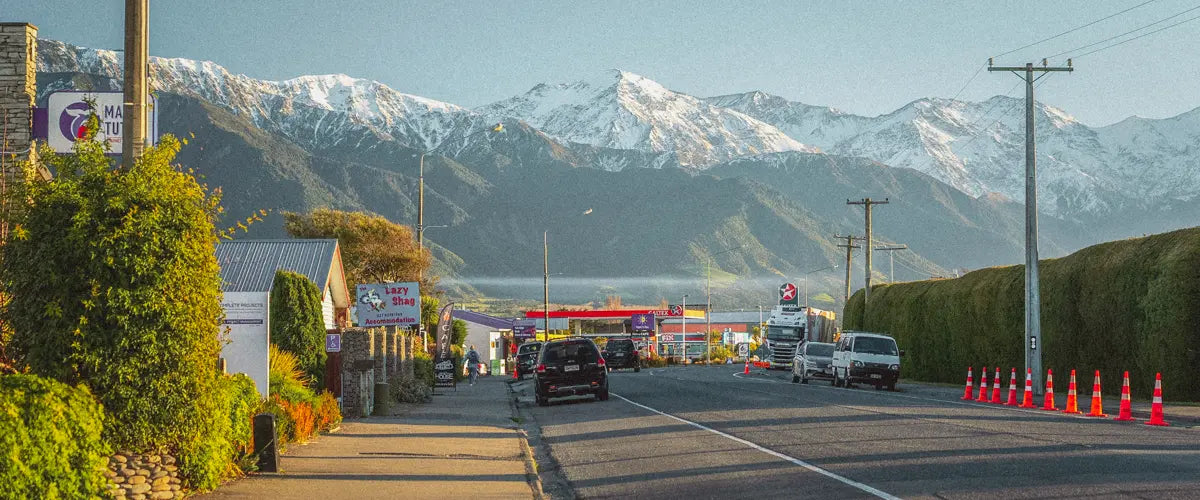
[takeaways] • New Zealand's UV index is among the highest in the world — high-SPF sunscreen is essential every day, including overcast ones.
• Sandflies are brutal in South Island and Fiordland — insect repellent with DEET is non-negotiable, not optional.
• New Zealand weather can change from sunshine to torrential rain within minutes — always carry a waterproof jacket regardless of the forecast.
• Tap water is safe to drink throughout New Zealand — bring a reusable bottle and refill freely.
• Download offline maps before you leave — mobile coverage drops significantly outside of major towns and on scenic routes. [/takeaways]
New Zealand's landscapes are spectacular, the roads are extraordinary, and the two-week self-drive itinerary is one of the most rewarding travel experiences on the planet. But packing for a New Zealand road trip requires a little more thought than most destinations — the weather changes fast, the outdoor activities are physically demanding, and some of the remotest stretches of the South Island will leave you genuinely without phone signal for hours at a time.
This packing list has been put together specifically for a two-week self-drive road trip, complementing our New Zealand road trip itinerary. Whether you're based in a campervan, moving between accommodation each night, or mixing the two, these are the items you'll be grateful you packed — and a few you'll regret leaving behind.
New Zealand road trip packing overview
The golden rule for packing a New Zealand road trip is this: prepare for four seasons in a single day. That's not a cliche — it's a genuine daily reality, particularly on the South Island and in Fiordland. A morning that starts in sunshine on the shores of Lake Tekapo can turn into a cold, windswept afternoon by the time you reach Milford Sound.
The other key consideration is that you'll be living out of a car or campervan for two weeks. That means packing light, using compression bags where possible, and prioritizing versatile items over single-use ones. Everything in this list earns its space.
What to pack for a New Zealand road trip
We've broken this packing list into four categories to make it easy to work through before you travel. Run through each section, tick off what you have, and make sure nothing gets left behind.
[numbered title="Clothing" pill="Layer for 4 seasons in a day"]A layering system is more practical than heavy single garments. Waterproof outer, insulating mid-layer, and breathable base layers cover the full range of NZ conditions.[/numbered] [numbered title="Outdoor Gear" pill="Hiking and all weather"]New Zealand's best experiences are outdoors — sandfly repellent, high-SPF sunscreen, and a good daypack are as essential as your passport.[/numbered] [numbered title="Road Trip Essentials" pill="Life in the car"]Two weeks on the road means planning for long stretches without towns. Offline maps, cash, snacks, and a reusable coffee cup will serve you well.[/numbered] [numbered title="Documents and Tech" pill="Before you leave home"]Travel insurance, an international driving permit if required, and a New Zealand eSIM are the three things to sort before anything else.[/numbered]
Clothing
New Zealand's unpredictable weather means a layering system is essential. Rather than packing heavy sweaters or thick coats, build a system of lightweight pieces you can add and remove throughout the day.
[tip title="Merino wool is the best investment you can make for NZ"]New Zealand is the home of merino wool, and for good reason — it regulates temperature, resists odor, and dries quickly. A merino base layer and mid-layer combination is far more versatile than cotton equivalents and takes up significantly less space in a bag or campervan.[/tip]
Here is the core clothing list for a two-week New Zealand road trip:
- Waterproof jacket — not just shower-resistant, but genuinely waterproof. This is the single most important item on this list. Pack it every day.
- Fleece or insulating mid-layer — for layering over a base and under a waterproof on cold days.
- Thermal base layers (top and bottom) — essential for Milford Sound, the Remarkables, and any early morning start in the South Island.
- Lightweight t-shirts (4–5) — breathable fabric, quick-dry where possible.
- Hiking pants (2 pairs) — quick-dry, comfortable for long drives and day walks alike.
- Shorts (1–2 pairs) — for warmer North Island days and beach stops.
- Swimwear — for hot pools, beaches, and lake swims.
- Warm hat and gloves — for South Island mornings and any high-altitude stops.
- Wide-brimmed sun hat — for UV protection. More important than it sounds in NZ.
- Waterproof hiking boots — essential for any of the Great Walks or day hikes. Do not leave these behind.
- Sandals or casual shoes — for towns, cafes, and evenings.
- Merino wool or wool-blend socks (plenty) — blisters on a road trip are miserable.
Outdoor gear
New Zealand's best experiences are outdoors — and some of the country's most spectacular spots, particularly in Fiordland, come with conditions that require proper preparation.
[warning]New Zealand's UV index is among the highest in the world, and the danger is significantly underestimated by visitors. The ozone layer is thinner in the Southern Hemisphere, meaning UV radiation is more intense — even on overcast days. Sunburn can occur in as little as 10–15 minutes at peak UV levels. Always apply SPF 50+ sunscreen, reapply after swimming, and cover exposed skin during midday hours.[/warning] [warning]Sandflies in South Island New Zealand — particularly around Fiordland, Milford Sound, and the West Coast — are relentless and can cause intensely itchy bites that last days. Standard insect repellent is not sufficient. Always use a repellent containing DEET for any outdoor activity in these areas, and cover exposed skin in the evenings. This is not an exaggeration — sandflies have been known to ruin entire days on the Milford Track for unprepared visitors.[/warning]
- Insect repellent with DEET — non-negotiable for South Island, particularly Fiordland.
- SPF 50+ sunscreen — bring more than you think you'll need. Buy extra in NZ if you run out.
- Sunglasses with UV protection — polarized lenses are ideal for NZ lakes and coastline.
- Daypack (20–30 liters) — for day hikes, carrying layers, and camera gear.
- Reusable water bottle — tap water is safe throughout NZ. There is no reason to buy bottled water.
- Headlamp — for campsite evenings, predawn alpine starts, and power cuts in remote accommodation.
- Basic first aid kit — adhesive bandages, blister treatment, antiseptic, antihistamine, and any personal medications.
- Trekking poles (optional) — useful for longer hikes, especially the Routeburn or Tongariro.
- Buff or neck gaiter — versatile for wind, cold, and sandfly protection.
- Rain cover for daypack — if your daypack doesn't come with one, pack a dry bag.
[tip title="Tap water in New Zealand is safe — always carry a reusable bottle"]New Zealand has excellent tap water quality throughout the country, including in rural areas and campgrounds. There is no need to buy bottled water at any point during your road trip. A reusable bottle saves money, reduces plastic waste, and means you're never caught without hydration on a long hike.[/tip]
Road trip essentials
Living out of a car for two weeks requires a slightly different mindset from a standard hotel-based trip. These are the practical items that make the day-to-day significantly more comfortable.
[tip title="Download offline maps before you leave your last town"]New Zealand's most spectacular scenic routes — the Milford Road, the West Coast, the Catlins — have minimal or no mobile signal for long stretches. Download offline maps for the South Island via Google Maps or Maps.me before you set off each morning, and keep a physical road map in the car as a backup. Getting lost on a single-lane road at dusk with no signal is an experience worth avoiding.[/tip]
- Offline maps downloaded — Google Maps or Maps.me, downloaded before you lose signal.
- Physical road map or road atlas — available at gas stations and visitor centers throughout NZ.
- Car phone mount — for navigation while driving.
- Car charger and USB cables — for keeping devices charged on long drives.
- Portable power bank — for hikes where you won't have a car nearby.
- Cash in NZD — ATMs are scarce in rural towns. Always carry cash for freedom camping fees, small cafes, and markets.
- Reusable grocery bags — for supermarket runs and reducing waste.
- Small soft cooler bag — for keeping food and drinks cool between supermarket stops.
- Snacks for long stretches — distances between towns on the South Island can be long. Nuts, dried fruit, and energy bars are your friends.
- Reusable coffee cup — many New Zealand cafes offer small discounts for reusable cups, and NZ coffee is genuinely excellent.
- Dry bags — for keeping electronics and clothing dry in rain or on water-based activities.
- Compression packing cubes — for keeping a small car or campervan organized over two weeks.
[tip title="Cash is more important in rural New Zealand than most travelers expect"]Many small towns, campgrounds, freedom camping spots, and local food stalls in New Zealand do not accept international cards. Always withdraw NZD at major ATMs in Queenstown, Christchurch, or Te Anau before heading into remote areas. Running out of cash between towns can genuinely limit your options on the South Island.[/tip]
Documents and tech
Sort these before you book flights — some require lead time, and missing one can derail the whole trip.
[warning]New Zealand requires visitors from most countries to hold a valid international driving permit (IDP) in addition to their home country license. UK license holders can drive in NZ without an IDP, but the license must be in English. If your license is not in English, you must carry a certified translation or an IDP. Always check the current requirements for your nationality before you rent a vehicle.[/warning]
- Passport — with at least six months' validity beyond your travel dates.
- International driving permit — if required for your nationality.
- Travel insurance documents — including emergency contact numbers. New Zealand's ACC scheme covers accident treatment, but does not replace comprehensive travel insurance.
- Accommodation and activity confirmations — printed or saved offline.
- New Zealand NZeTA — most visitors require a New Zealand Electronic Travel Authority before arrival. Apply online well in advance.
- Camera or GoPro — New Zealand is one of the most photogenic countries in the world. Bring more storage than you think you'll need.
- NZ power adapter — New Zealand uses Type I plugs (the same as Australia). UK travelers will need an adapter.
- Universal USB charging hub — for campervans with limited power points.
[tip title="New Zealand uses Type I plugs — UK travelers need an adapter"]New Zealand's power outlets use the Type I plug — the angled two or three-pin style also used in Australia. UK plugs do not fit without an adapter. Pick one up before you travel or at the airport on arrival. Campervans typically have 12V car sockets and sometimes 240V hookups — always check before you book.[/tip] [esim flag="🇳🇿" label="New Zealand" data="10GB · 30 days" price="£11" href="/products/new-zealand" benefits="Instant QR setup · Reliable 4G and 5G · No contract"]Stay connected across New Zealand — no roaming charges[/esim] [faq] [q]What should I pack for a New Zealand road trip?[/q] [a]The essentials for a New Zealand road trip are a genuinely waterproof jacket, a layering system for rapidly changing weather, SPF 50+ sunscreen, DEET-based insect repellent for sandflies, waterproof hiking boots, offline maps downloaded before you lose signal, cash in NZD for rural areas, and a reusable water bottle. New Zealand's tap water is safe to drink throughout the country.[/a] [q]Are sandflies really that bad in New Zealand?[/q] [a]Yes — particularly in Fiordland, along the West Coast, and around Milford Sound on the South Island. Sandfly bites are intensely itchy and can persist for several days. Standard insect repellent provides limited protection — always use a repellent containing DEET in these areas, cover exposed skin in the evenings, and move quickly through shaded, damp areas where sandflies congregate. This is one of the most commonly underestimated aspects of a South Island road trip.[/a] [q]Is tap water safe to drink in New Zealand?[/q] [a]Yes — tap water is safe to drink throughout New Zealand, including in rural areas and at most campgrounds and holiday parks. There is no need to buy bottled water at any point during a road trip. A reusable bottle and the ability to refill freely is one of the simplest and most practical things about traveling in New Zealand.[/a] [q]Do I need an international driving permit for New Zealand?[/q] [a]UK license holders can drive in New Zealand without an international driving permit, provided their license is in English. Visitors whose licenses are not in English must carry a certified English translation or an IDP. Always check the current requirements for your nationality before renting a vehicle — requirements can change, and rental companies may have their own policies.[/a] [q]What is the UV like in New Zealand?[/q] [a]New Zealand has one of the highest UV indexes in the world, due to the thinner ozone layer in the Southern Hemisphere. UV radiation is significantly more intense than at equivalent latitudes in the Northern Hemisphere, and sunburn can occur in as little as 10–15 minutes at peak levels — even on overcast days. Always apply SPF 50+ sunscreen, reapply after swimming or sweating, wear a wide-brimmed hat, and cover exposed skin during midday hours.[/a] [q]Do I need an eSIM for New Zealand?[/q] [a]A SIMOVO New Zealand eSIM is one of the most practical things to sort before your road trip. It activates on landing, connects you to New Zealand's best available networks, and gives you prepaid data for navigation, finding accommodation, and staying in touch. Note that coverage drops significantly on remote scenic routes — always download offline maps before leaving towns, as an eSIM cannot overcome genuine coverage gaps in Fiordland and the West Coast.[/a] [/faq] [esim flag="🇳🇿" label="New Zealand" data="10GB · 30 days" price="$13.70" href="/products/new-zealand" benefits="Instant QR setup · Reliable 4G and 5G · No contract"]Stay connected across New Zealand — no roaming charges[/esim]