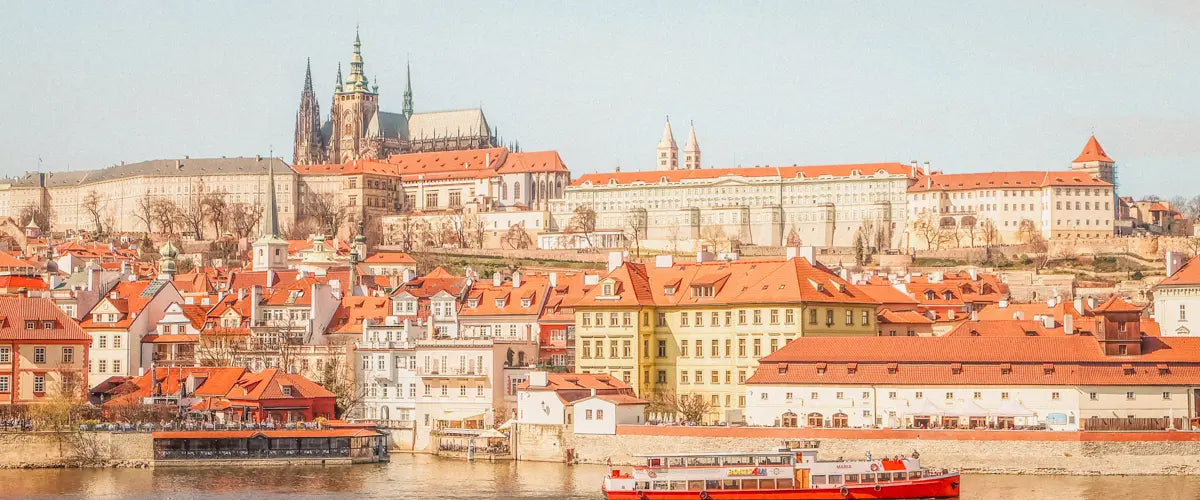
[takeaways] • Prague's five must-see attractions are Prague Castle, the Jewish Quarter, Charles Bridge, St. Vitus Cathedral, and Old Town Square — each offering a different window into the city's history.
• Prague Castle covers almost 70,000 square meters and is recognized as the largest coherent castle complex in the world.
• The best time to visit Prague is spring (March to May), when temperatures are mild and the city is at its most naturally beautiful, before summer crowds and prices arrive.
• Tap water in Prague is completely safe to drink — there's no need to buy bottled water unless you prefer it.
• Withdraw Czech Koruna (CZK) from your bank before you travel rather than relying on city ATMs, for both cost and safety reasons.
• A SIMOVO eSIM for the Czech Republic keeps you connected to navigate Prague's cobbled streets and find every attraction on your list. [/takeaways]
Czechia (the Czech Republic) is truly one of Europe's best hidden gems — it sometimes goes under the radar of other European breaks. It's a genuinely stunning country that's popular with visitors for its medieval, almost fairytale architecture and landscapes, and it's a big hit with UNESCO enthusiasts. Prague, its capital, is a must-see destination for anyone keen to dive deeper into Europe's fascinating history.
There are plenty of things to do in Prague all year round, and in this guide, we take you through just a few of the top attractions worth your flight money. Whether you're a first-time traveler building a Czechia itinerary or are heading back to the city after some years away, now's a great time to dip into our recommendations.
Best things to do in Prague: our top picks
For this guide, we consulted with the SIMOVO crew to narrow down just a few of Prague's highlights — and for the record, we recommend checking out the following five attractions.
[numbered title="Prague Castle" pill="Historic landmark"]No trip to Prague should ever be complete without a tour around its majestic castle — perhaps the most important monument in the city, if not the broader Czech Republic. Thought to have been built back in the 9th century, the castle covers almost 70,000 square meters, making it the largest coherent castle complex in the world according to the official Prague Castle website.[/numbered] [numbered title="Jewish Quarter" pill="Literary and cultural history"]World-famous as the birthplace of celebrated novelist Franz Kafka, Prague's Jewish Quarter is a must-see for anyone with a passing interest in European literary history. Jewish people settled here as part of an ordered ghetto in the 1400s — the area's synagogues, including the Maisel, Klausen, and the visually stunning Spanish Synagogue, offer a fascinating look at a history of turbulence and resistance.[/numbered] [numbered title="Charles Bridge" pill="Gothic architecture"]Charles Bridge is a key reason many people visit Prague in the first place — an exceptional example of classic Czech architecture spanning the Vltava River, guarded by 30 sculptures each modeled after a different saint. Once the main link between Prague Castle and the Old Town, it's now a fantastic vantage point for some of the best views in the city, and a popular spot for street performers during peak season.[/numbered] [numbered title="St. Vitus Cathedral" pill="Royal and religious history"]St. Vitus Cathedral is a great day out for anyone interested in local religious history or simply a feast for the eyes. Many saints and archbishops have been buried here over the years, and it's one of Czech history's most important royal landmarks, having hosted numerous coronations. The cathedral took centuries to complete, and the central St. Wenceslas Chapel houses the eponymous saint's tomb.[/numbered] [numbered title="Old Town Square" pill="UNESCO Heritage Site"]On the other side of Charles Bridge, Old Town Square is a UNESCO World Heritage Site home to the stunning baroque Nicholas Church and the famous Prague Astronomical Clock at Old Town Hall, whose moving apostles walk around on the hour from 8am to 11pm. Local legend holds that the clockmaker was blinded by local authorities so his design could never be replicated.[/numbered] [esim flag="🇨🇿" label="Czech Republic" data="10GB · 30 days" price="$8.50" href="/products/czech-republic" benefits="Instant QR setup · Reliable 4G/5G · No contract"]Stay connected across Prague — navigate cobbled streets and find every attraction[/esim]
When is the best time to visit Prague?
We recommend visiting Prague during spring — any time between March and May. After that, the city tends to get hot and busy, and costs may rise for accommodations and attractions. There's nothing stopping you from enjoying summer here too — just be ready to dress light and keep cool.
There will be some rain during both spring and fall in Prague, but it stays nice and cool — arguably making these the best times of year to see the city at its most naturally beautiful.
[tip title="Visit in spring for mild weather and lower prices"]March through May offers the most comfortable balance of weather and cost in Prague. Summer brings heat and higher prices, so spring (or fall, for similarly mild conditions) is the sweet spot for most visitors.[/tip]
Top tips for visiting Prague
If you're planning a stay in Prague, here are some final tips to take with you before your flight lands.
[tip title="Wear comfortable walking shoes"]Prague is one of the most accessible cities to tour on foot, but keep in mind that many of its streets are cobbled. Comfortable walking boots or shoes will make a real difference to your day.[/tip] [tip title="Visit popular attractions at daybreak to avoid crowds"]If you want to avoid peak crowds around Prague's best-loved architecture and attractions, head to spots like Charles Bridge at daybreak — visitors flock here shortly after morning breaks, so getting there early pays off.[/tip] [tip title="Withdraw Czech Koruna before you travel"]Be sure to take Czech Koruna (CZK) with you so you can enjoy Prague to the fullest. You can withdraw money in the city, but for safety and to avoid high costs, we recommend withdrawing with your bank before you travel.[/tip] [tip title="Explore beyond the touristy areas"]Many tourists advise against investing too much time in the busiest tourist areas. Outer neighborhoods, like Karlin, are recommended for their authentic charm and often lower prices than the city center.[/tip] [tip title="Tipping is appreciated but not mandatory"]You don't have to worry too much about tipping in Prague or Czechia in general, but it's usually polite to tip up to 10% if you've had a great experience. Always check your bill first, in case service charges are already included.[/tip] [tip title="Tap water is safe to drink"]The tap water in Prague is completely safe to drink, and you can enjoy ice in bars and restaurants without concern. There's no need to buy bottled water unless you simply prefer it.[/tip] [faq] [q]What are the best things to do in Prague?[/q] [a]Prague's top five attractions are Prague Castle (the largest coherent castle complex in the world), the historic Jewish Quarter, the iconic Charles Bridge, St. Vitus Cathedral, and Old Town Square — home to the famous Prague Astronomical Clock. Between them, they cover centuries of Czech history, architecture, and culture.[/a] [q]When is the best time to visit Prague?[/q] [a]Spring (March to May) is the best time to visit Prague, offering mild temperatures and lower prices before the summer crowds and heat arrive. Fall is also a good alternative for similarly cool, pleasant conditions. Summer is enjoyable but busier and more expensive.[/a] [q]Is Prague Castle really the largest castle in the world?[/q] [a]Prague Castle is recognized as the largest coherent castle complex in the world, covering almost 70,000 square meters. It dates back to the 9th century and has undergone numerous renovations and architectural additions over the centuries.[/a] [q]Is it safe to drink tap water in Prague?[/q] [a]Yes — tap water in Prague is completely safe to drink, and ice in bars and restaurants is also safe to consume. There's no need to buy bottled water during your visit unless you have a personal preference for it.[/a] [q]Do you need to tip in Prague?[/q] [a]Tipping is not mandatory in Prague or the wider Czech Republic, but it's considered polite to tip up to 10% if you've had a particularly good experience. Always check your bill first, as some restaurants already include a service charge.[/a] [q]Do I need an eSIM for visiting Prague?[/q] [a]A SIMOVO eSIM for the Czech Republic is a convenient way to stay connected throughout your trip — useful for navigating Prague's cobbled streets, finding attractions, and checking opening times on the go. It means no hunting for a local SIM card on arrival.[/a] [/faq] [esim flag="🇨🇿" label="Czech Republic" data="10GB ·30 days" price="$8.50" href="/products/czech-republic" benefits="Instant QR setup · Reliable 4G/5G · No contract"]Get connected before you land in Prague[/esim]