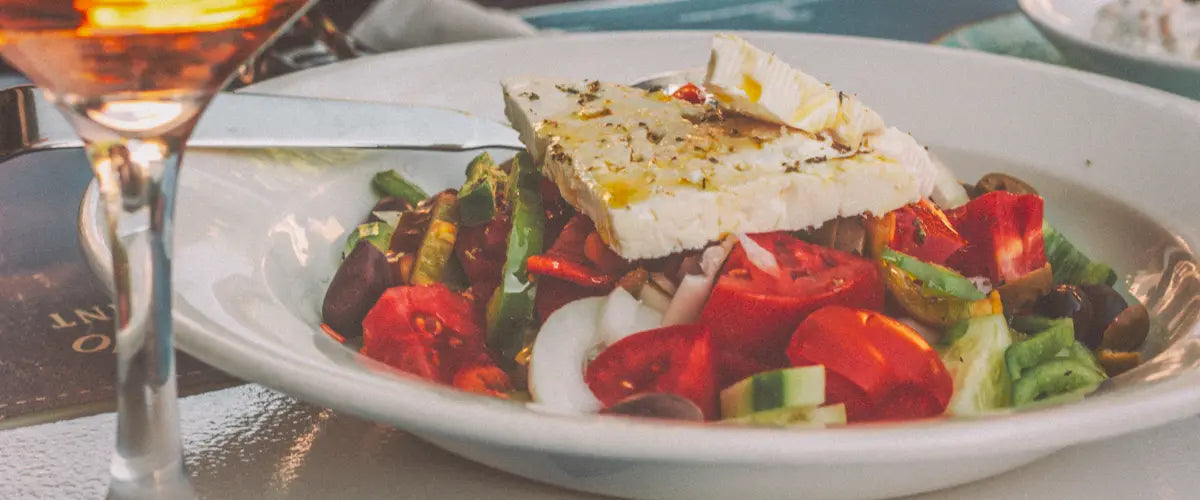
It's safe to say that Greek food is among the tastiest you'll come across in Europe — and when it comes to traditional Mediterranean flavours, you really can't beat Greek recipes that go back generations.
If you read our journals regularly, you'll already know that we've offered up an introduction to Greek food to tempt your taste buds. This time around, we're focusing specifically on traditional Greek food — dishes that, while mimicked overseas, really cannot be bettered at home.
Greek cuisine overview
Traditional Greek cuisine is all about freshness and natural ingredients. Superfood-packed veggie dishes are piled high, and there's a real emphasis on cool salads and dips to help you beat the heat.
Even a few hours into dining in Greece, you'll find that meals are social affairs. The concept of meze allows friends and family to come together and enjoy small sharing plates and dips. While you're free to eat alone, it's greatly encouraged that you split meals with the groups you're travelling with.
In terms of classic Greek ingredients, you can always expect lemon, oregano, and good old extra virgin olive oil. Lamb and goat tend to be the most favoured meats — and to enjoy the best in traditional Greek food, you don't have to book a restaurant table. There's a burgeoning street food scene well worth tucking into.
Traditional Greek food dishes to try
If you're planning your Greece itinerary around food and drink, the SIMOVO team has more than a few traditional dishes to recommend. While our companion guide dives deep into the absolute must-eats for beginners, we've focused here on traditional flavours — though you're likely to find modern twists on all of the below as you explore restaurants across the region.
[numbered title="Moussaka" pill="The Greek classic"]Possibly the most famous of all traditional Greek dishes worldwide — layers of aubergine, potato, meat, and béchamel sauce. The real deal at a local taverna is incomparable.[/numbered] [numbered title="Dolmades" pill="Stuffed vine leaves"]Vine or grape leaves stuffed with herbs, onions, rice, and olive oil — traditionally vegetarian but also found with minced beef or lamb. A meze staple across Greece.[/numbered] [numbered title="Gyros" pill="Greek street food staple"]Shaved meat and vegetables served in pita bread with cool tzatziki. Think of it as a spicy, flavour-packed alternative to a sandwich — and a street food staple you'll find everywhere.[/numbered] [numbered title="Bougatsa" pill="Breakfast pastry"]A custard-filled phyllo pastry that makes for a wonderful breakfast or mid-morning treat, also available with savoury fillings like feta. Best enjoyed dusted with icing and a strong Greek coffee.[/numbered] [numbered title="Greek Salad" pill="Fresh & regional"]More than just tomatoes and feta — expect bell peppers, red onion, olives, and olive oil, with regional variations throughout the country. Simple, fresh, and consistently excellent.[/numbered] [numbered title="Tzatziki" pill="Cool yogurt dip"]Cucumber and salted yogurt with thyme, mint, lemon juice, and parsley. Served with pita as part of meze or alongside meat dishes — and one of the most refreshing accompaniments to spicier food.[/numbered]Moussaka
Moussaka is possibly the most famous of all traditional Greek food dishes, with plenty of different twists available to try worldwide. However, you really cannot beat the real deal — a delicious combination of aubergine, potato, meat, and béchamel sauce. Give it a go at a traditional taverna or a modern establishment across the islands or on the mainland.
Dolmades
Dolmades is another Greek classic based around stuffing vine or grape leaves with herbs, onions, rice, olive oil, and more. It's typically a vegetarian dish first and foremost, but you will also find varieties that include minced beef or lamb. Dolmades feature heavily in meze spreads depending on where you dine out — be prepared to try it as a small shared plate rather than a main meal.
Gyros
Gyros are staple finger foods in Greece, usually served at street food vendors or with salad on the side. Similar to a kebab — shaved meat and vegetables served in pita bread, usually with cool tzatziki alongside. Consider it a spicy, flavour-packed take on the sandwich that puts your office lunch firmly to shame.
Bougatsa
Bougatsa is a custard-based breakfast treat or mid-morning staple, made with crispy phyllo pastry. Some may see it as a type of custard tart — but you can also enjoy it with more savoury fillings such as feta cheese. These pastries usually go down wonderfully with a dusting of icing sugar and a hot Greek coffee. You'll forget cereal and toast ever existed.
Greek salad
Yes — the Greek salad really does have roots in the region, and there are a few different regional takes depending on where you go. Expect juicy tomatoes, bell peppers, red onion, olives, feta, and a generous pour of olive oil. Simple, fresh, and consistently one of the most satisfying things you'll eat in Greece.
Tzatziki
If you're a dip fan, chances are you're already familiar with tzatziki — a cool dip made from cucumber and salted yogurt. It's usually served with pita bread as part of meze, or alongside meat dishes. It's a surprisingly simple Greek staple, made from natural ingredients such as thyme, mint, lemon juice, and parsley, with slight variations depending on where you travel.
Greek street food culture
Street food has exploded across the Mediterranean over the past decade, and Greece has dived into traditional foodie vending feet-first. Across cities like Athens, you'll commonly find talented chefs serving up fresh gyros and souvlaki — meaning you'll never have to look too far for an authentic take on fast food. Leave the burgers and fries at home for a little while.
[tip title="Carry cash and choose the busiest stalls"]Always carry cash when exploring Greek street food — not all vendors accept international cards. And always prioritise the busiest stalls: the more popular a vendor is, the more likely it is they are serving the freshest, highest-quality food.[/tip]Where to try Greek food
It's easier than ever to sample Greek food from home thanks to a boom in Mediterranean cuisine across the West. We do suggest trying some dishes before you travel — but you will not experience better quality traditional Greek food than in Greece itself.
For traditional eats, hunt down small, local tavernas that specialise in meze and buffet options. Take the time to enjoy modern restaurants too, to get a real taste of the balance between tradition and creative recipe building. The best part is you'll never go hungry — traditional Greek cuisine can be enjoyed throughout the mainland and across the islands. Be sure to build a dining itinerary alongside our sailing guide.
Greek food travel tips
Here's some quick-fire advice from the SIMOVO team on how to make the most of a foodie tour of Greece and its islands.
[tip title="Sample as much meze as you can"]The whole point of meze is to try lots of little things and share in the experience with the group. Mains go to the centre of the table, starters around the outside — dive in, share freely, and don't overthink the order.[/tip] [tip title="Eat late — dinner in Greece starts at 9pm"]Be prepared to eat later than you usually might. Locals don't always enjoy dinner until around 9pm, so save some room late in the day and embrace the pace. Arriving at a Greek restaurant at 6pm often means sitting in an empty room.[/tip] [tip title="Prioritise locally caught seafood on the coast"]If you're dining along the coast or on the islands, always prioritise the locally caught seafood. Freshness is the cornerstone of Greek coastal cuisine — and the difference between freshly caught fish and anything else is immediately obvious on the plate.[/tip] [tip title="Visit local markets for the best ingredients"]If you're making your own dishes while you travel, visit local traditional markets for the freshest and highest-quality ingredients. Greek markets are excellent — and a visit is worthwhile even if you're not cooking, purely for the atmosphere.[/tip] [esim flag="🇬🇷" label="Greece" data="10GB · 30 days" price="£9" href="/products/greece" benefits="Instant QR setup · Reliable 4G/5G · No contract"]Find the best food in Greece without roaming charges[/esim] [faq] [q]What is the most famous traditional Greek dish?[/q] [a]Moussaka is arguably the most internationally recognised traditional Greek dish — layers of aubergine, potato, minced meat, and béchamel sauce baked together. It's widely imitated abroad but genuinely difficult to replicate at the level of quality you'll find at a local Greek taverna. Gyros and dolmades are also among the most beloved traditional dishes.[/a] [q]What is meze?[/q] [a]Meze is a style of dining built around small shared plates — a spread of starters, dips, and appetisers including dolmades, tzatziki, cheese, olives, and vegetables placed on the table for the whole group to share. It is central to Greek food culture and one of the best ways to try a wide variety of traditional dishes in a single sitting.[/a] [q]What is tzatziki?[/q] [a]Tzatziki is a cool dip made from salted yogurt and cucumber, seasoned with thyme, mint, lemon juice, and parsley. It is served as part of meze with pita bread, or as an accompaniment to meat dishes and gyros. It is refreshing, naturally cooling in hot weather, and one of the most versatile staples in Greek cuisine.[/a] [q]What is bougatsa?[/q] [a]Bougatsa is a traditional Greek pastry made from crispy phyllo dough, typically filled with custard cream and dusted with icing sugar. Savoury versions with feta cheese also exist. It is most commonly eaten as a breakfast or mid-morning snack, often paired with a strong Greek coffee. It is particularly popular in northern Greece and is now found across the country.[/a] [q]When do Greeks eat dinner?[/q] [a]Greeks typically eat dinner late — often not until 9pm or 10pm. This is deeply ingrained in the culture, particularly in summer when the day stretches long and hot. Arriving at a restaurant earlier than 8pm will often mean a near-empty room. Embrace the rhythm of the local schedule and plan accordingly — it makes the dining experience significantly better.[/a] [q]Do I need an eSIM for Greece?[/q] [a]A SIMOVO Greece eSIM is one of the most practical things to sort before any trip. At £9 for 10GB over 30 days, it connects you to Greece's best available networks on landing, letting you search for local restaurants, navigate to markets, and explore the food scene on the go — without roaming charges or the need for public WiFi.[/a] [/faq] [esim flag="🇬🇷" label="Greece" data="10GB · 30 days" price="£9" href="/products/greece" benefits="Instant QR setup · Reliable 4G/5G · No contract"]Find the best food in Greece without roaming charges[/esim]