[takeaways] • The five traditional Korean dishes to prioritize are kimchi, bibimbap, naengmyeon, tteokbokki, and samgyeopsal.
• Korean cuisine is built around a balance of spicy, sweet, and savory — with sesame, ginger, and garlic as the core flavor base.
• Always choose the busiest street food vendors — in Korea, a long line means the vendor is trusted, not just popular. And lines move fast.
• Carry cash for street food stalls — not all vendors accept international card payments.
• Korean restaurant service is fast — don't expect a leisurely pace. Keep up with the rhythm of the meal. [/takeaways]
There are plenty of great reasons to explore Korea, but one that often comes near the top is its tremendous traditional cuisine. While K-Food and snacks have exploded across the West over the past few years, many would-be foodie travelers have yet to experience the best in traditional Korean dishes.
Several of the SIMOVO team travel to and from South Korea purely for the food — and while you can certainly sample some of the recipes overseas, nothing beats the real deal, whether from a street food vendor or prepared freshly in a traditional restaurant.
In this guide, we take a deep dive into the traditional Korean dishes you should prioritize when scanning TripAdvisor and taking to the streets in search of the best that South Korean cuisine has to offer.
Korean cuisine overview
We already have an introductory guide to Korean food for first-time travelers that zooms in on the tastiest and tangiest the region has to offer. In this guide, we're leaning more toward the traditional side — Korean cuisine that's stood the test of time, and which may have taken something of a back seat to newer creative takes on old favorites.
Korean cuisine offers several fundamentals. For the most part, you can expect warm, hearty dishes based on steamed short-grain rice, with a focus on fermented vegetables. What really strikes us about Korean dishes is the fantastic balance of texture and flavor — a lovely crunch or a chew, with a real combination of spicy, sweet, and savory in every mouthful.
In terms of ingredients, traditional Korean cuisine typically revolves around sesame, ginger, and garlic — strong, warming flavors that, when combined with good texture and bite, really do fill you up fast. There's a reason so many people regard Korean cuisine as some of the most memorable they've ever experienced.
Traditional Korean dishes you must try
Having surveyed the SIMOVO team members who regularly visit Korea, we found that no foodie trip should ever leave out kimchi, bibimbap, naengmyeon, tteokbokki, and samgyeopsal. Here's why.
[numbered title="Kimchi" pill="Fermented and fiery"]The cornerstone of Korean cuisine — fermented vegetables with ginger and garlic that appear in almost every meal. Incredibly versatile and genuinely one of the world's great side dishes.[/numbered] [numbered title="Bibimbap" pill="Rice bowl classic"]A hearty mixed rice dish served in a variety of meat and vegetarian versions, often with seaweed — introduced piping hot and mixed to taste with additional oils at the table.[/numbered] [numbered title="Naengmyeon" pill="Cold noodle dish"]Thin noodles made from potato or buckwheat, served cold in a broth or with cucumber, pear, and egg. A summer staple with roots in North Korea — cooling, light, and quietly addictive.[/numbered] [numbered title="Tteokbokki" pill="Chewy rice cake snack"]Chewy rice cakes enjoyed on the go or in a spicy sauce-based dish — a go-to for street food exploration in Korea. Compare vendors to find your favorite version.[/numbered] [numbered title="Samgyeopsal" pill="Korean BBQ pork belly"]Grilled pork belly cooked at the table before you eat — typically served with kimchi, sesame oil, or soybean paste. A Korean BBQ classic and one of the great social dining experiences in the country.[/numbered]
Kimchi
There is absolutely no trip you should make to Korea without trying kimchi at least once. This tasty, super-healthy dish consists of a variety of fermented vegetables and is extremely versatile — in some spots across Korea, you'll find it served as part of main courses, while in others it comes as a dish in its own right.
It combines all of those classic Korean ingredients — a warm, spicy hit of ginger and garlic — and we recommend trying it from a local Korean store before you leave home so you can get a feel for it. That said, you really won't be able to move for it when you land, so waiting until you arrive is equally valid.
[tip title="Try kimchi at a Korean restaurant before you travel"]Kimchi has become widely available at Korean restaurants and supermarkets in the US. Trying it at home before you fly gives you a baseline for comparison — and makes it easier to appreciate just how much better the real thing tastes when you're in Seoul. You can also pick some up from food shopping in Korea to bring home.[/tip]
Bibimbap
Bibimbap is another traditional dish that made the cut in our introduction to Korean food, and for good reason. This rice-based main course comes in a variety of recipes — you can enjoy meat and vegetarian versions, and for many travelers it's their first taste of seaweed. The dish is served piping hot into a bed of rice and mixed to taste with additional oils at the table.
Naengmyeon
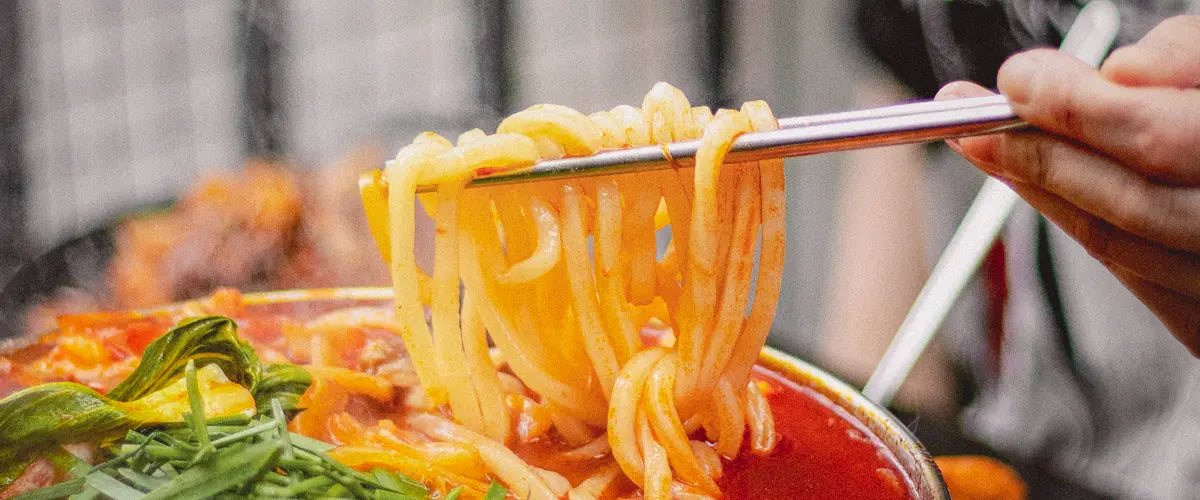
From rice to noodles — naengmyeon refers to Korea's famous thin noodle dish, traditionally made from potato or buckwheat. It's a dish that actually has roots in the North but is widely enjoyed across South Korea. A summer staple typically served with fish, in a broth, or with cucumber and pear — and like many Korean dishes, with an egg on top if you'd like one.
Tteokbokki
Back to rice — specifically, rice cakes. Tteokbokki is a type of chewy snack you can enjoy on the go or as part of a sauce-based meal. It tends to be a go-to for anyone exploring street food in Korea, and we seriously recommend comparing different vendors to find the version that's made your way.
Samgyeopsal
Samgyeopsal is a Korean BBQ staple — specifically, grilled pork belly cooked at the table before you eat. Another summer favorite, it's commonly served with kimchi and either sesame oil or soybean paste. Like many traditional Korean dishes, there are plenty of different ways to enjoy it, and most will leave you wanting to order another round.
Korean street food culture
While there are plenty of restaurants around the region, we recommend making exploration of the local street food scene a priority in your Korea itinerary. Fast on cooking and on service, vendors frequent street corners and specific districts throughout the country.
[tip title="Hongdae in Seoul is one of the best street food districts in the country"]Hongdae in Seoul is one of the most vibrant street food destinations in South Korea — rolling carts, traditional treats, and an electric atmosphere that exemplifies the country's unique "moving restaurant" culture. Head here for tteokbokki, filled pancakes, and savory seaweed rolls called gimbap.[/tip]
[esim flag="🇰🇷" label="South Korea" data="10GB · 30 days" price="$9.40" href="/products/south-korea" benefits="Instant QR setup · Reliable 4G/5G · No contract"]Find the best food in South Korea without roaming charges[/esim]Korean food tips for travelers
While it's usually a good idea to just let the sights and smells of Korean cuisine guide you, here are a few quick tips to help you make the most of your culinary journeys.
[tip title="Always choose the busiest street food vendors"]A busy vendor in Korea means trusted, not just popular — and lines move remarkably fast. Don't be put off by a long line. It will move, the food will be worth it, and the atmosphere around a popular Korean street food cart is part of the experience.[/tip] [tip title="Carry cash for street food stalls"]Not all street food vendors in South Korea accept international card payments. Always carry Korean won so you're never caught short at a stall you want to try — particularly at smaller vendors and market stalls away from the main tourist areas.[/tip] [tip title="Korean restaurant service is fast — keep up"]Speed is key in Korean dining culture. Not only are vendors fast, but restaurant service moves at a similarly brisk pace. Be ready to order, eat, and move on — don't expect the leisurely dinner pace of Mediterranean dining. Embrace the rhythm and you'll enjoy the experience far more.[/tip] [tip title="Mix street food and restaurants for the full picture"]You won't find everything Korea has to offer in cuisine just at street vendors. The best foodie experience comes from mixing both — street food for atmosphere and authenticity, traditional restaurants for depth and presentation. Don't limit yourself to one or the other.[/tip] [faq] [q]What are the most famous traditional Korean dishes?[/q] [a]The five most important traditional Korean dishes to try are kimchi (fermented vegetables — the cornerstone of Korean cuisine), bibimbap (mixed rice bowl with meat or vegetables), naengmyeon (cold thin noodles in broth, a summer staple), tteokbokki (chewy spiced rice cakes, popular as street food), and samgyeopsal (grilled pork belly cooked at the table, served with kimchi). These five dishes appear across street food scenes, traditional restaurants, and home cooking throughout the country.[/a] [q]What is kimchi?[/q] [a]Kimchi is a traditional Korean dish of fermented vegetables — most commonly napa cabbage and Korean radishes — seasoned with ginger, garlic, chili pepper, and salt. It is a cornerstone of Korean cuisine, served as a side dish at almost every meal, and is one of the most nutritionally rich and culturally significant foods in the country. Over 200 varieties of kimchi exist across different regions and seasons.[/a] [q]What is bibimbap?[/q] [a]Bibimbap is a popular Korean rice dish — the name literally means "mixed rice." It consists of a bowl of warm steamed rice topped with sautéed and seasoned vegetables, gochujang (chili pepper paste), soy sauce, and often a fried egg and sliced meat. The whole dish is mixed together at the table before eating. It comes in meat and fully vegetarian versions and is one of the most widely recognized Korean dishes internationally.[/a] [q]What is samgyeopsal?[/q] [a]Samgyeopsal is grilled pork belly — one of the most popular dishes in Korean BBQ culture. Thick slices of pork belly are cooked on a grill built into the dining table, then wrapped in lettuce leaves with kimchi, garlic, sesame oil, or soybean paste. It is a highly social dining experience, typically enjoyed with friends or family over an extended meal. It is widely considered one of the most enjoyable ways to experience traditional Korean food culture.[/a] [q]Where can I find the best street food in Seoul?[/q] [a]Hongdae is widely considered one of the best street food districts in Seoul — known for its rolling carts, youthful atmosphere, and wide range of traditional snacks including tteokbokki, gimbap (savory seaweed rolls), and filled pancakes. Gwangjang Market is another essential stop — one of the oldest and most celebrated traditional markets in the country, famous for bindaetteok (mung bean pancakes) and mung bean porridge.[/a] [q]Do I need an eSIM for South Korea?[/q] [a]A SIMOVO South Korea eSIM is one of the most practical additions to any food-focused Korea trip. At $9.40 for 10GB over 30 days, it lets you search TripAdvisor for restaurants, navigate between street food districts, check vendor reviews, and stay connected throughout your stay — without roaming charges or the need to rely on restaurant WiFi.[/a] [/faq] [esim flag="🇰🇷" label="South Korea" data="10GB · 30 days" price="$9.40" href="/products/south-korea" benefits="Instant QR setup · Reliable 4G/5G · No contract"]Find the best food in South Korea without roaming charges[/esim]